
For revenue and product leaders, launching an AI-enabled service raises a question that pricing alone cannot answer: can the business deliver, control, and charge for the offer it wants to sell?
AI can change the economics of an established product without changing its customer base. A subscription that once provided access to software may now include document processing, autonomous workflows or continuous background activity. Customers can receive more value and generate more delivery costs without adding seats. Learn more: To monetize AI, enterprises need to rethink their billing approach.
A dedicated AI product faces the same challenge. The resources consumed to deliver a service may bear little resemblance to the unit customers want to buy. Your costs might accumulate through tokens, model calls, and compute time, while the customer pays for a completed document, or a resolved case.
The commercial foundations must connect these two perspectives. They need to establish what the customer buys, what consumption is permitted, when the business should intervene, and how the resulting charge is explained.
For a chief revenue or product officer, the immediate task is to make those requirements explicit and establish whether the business can support them.
Start with one offer and follow it through
Choose one planned AI-enabled offer or service with a clear customer need and a credible route to market. It could be an AI capability added to an existing subscription, a new consumption package or a standalone service.
Keep the scope specific enough to test. For example: a business automation subscription that includes 1,000 processed documents, with agreed charges or restrictions beyond that allowance.
Bring together Product, Commercial, Finance, Engineering, and customer-facing teams. Assign an accountable owner for the offer and identify who decides pricing, customer terms, consumption policy, and cost allocation. Learn why: Building the Commercial Operating Model for Monetizing AI.
Use the following 90-day review to define the requirements, test the connections and agree the next investment.
Days 1 to 30: Agree the offer and its boundaries
Start with what the customer understands and values. Define the unit being sold and how you will establish that it has been delivered.
If you charge for a successfully processed document, specify what “successfully processed” means. Decide how failures, retries, and partial results affect the charge, and which application or business system provides the evidence.
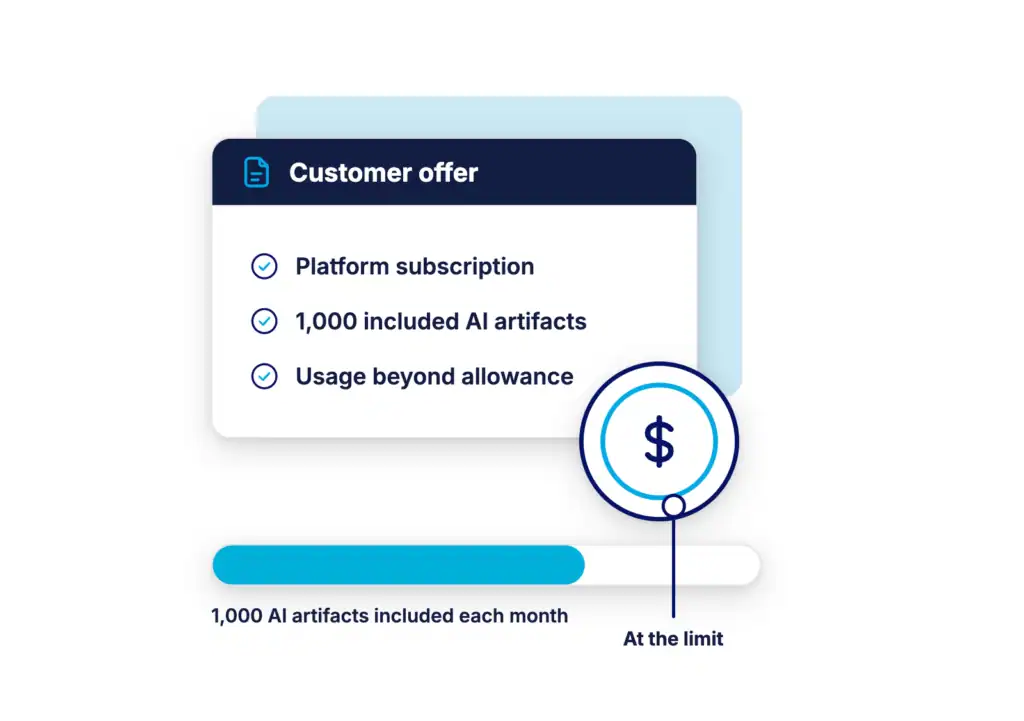
Then establish the commercial boundaries:
- Define what customers buy and the evidence needed to measure it.
- Agree included usage, additional charges, and what happens when an allowance or spending limit is reached.
- For existing customers, review agreements, renewal dates, and how the change will be explained.
- Identify delivery costs, the cost data available, and how costs will be attributed to the offer.
- Assign an owner to each commercial decision and record unresolved assumptions.
Pay particular attention to the relationship between price and cost. A simple customer-facing price may conceal several variable delivery costs. Understand how the offer behaves under typical usage, heavy usage, and unexpected background activity.
Output: A one-page offer definition, agreed customer terms and a list of information gaps.
Decision to make: Is the offer sufficiently clear to design its supporting processes, or do its pricing, evidence or cost assumptions need more work?
Days 31 to 60: Choose the control and integration approach
Once the offer is defined, decide how much control the service requires and where that control will be applied. Different activities within the same product may need different approaches:
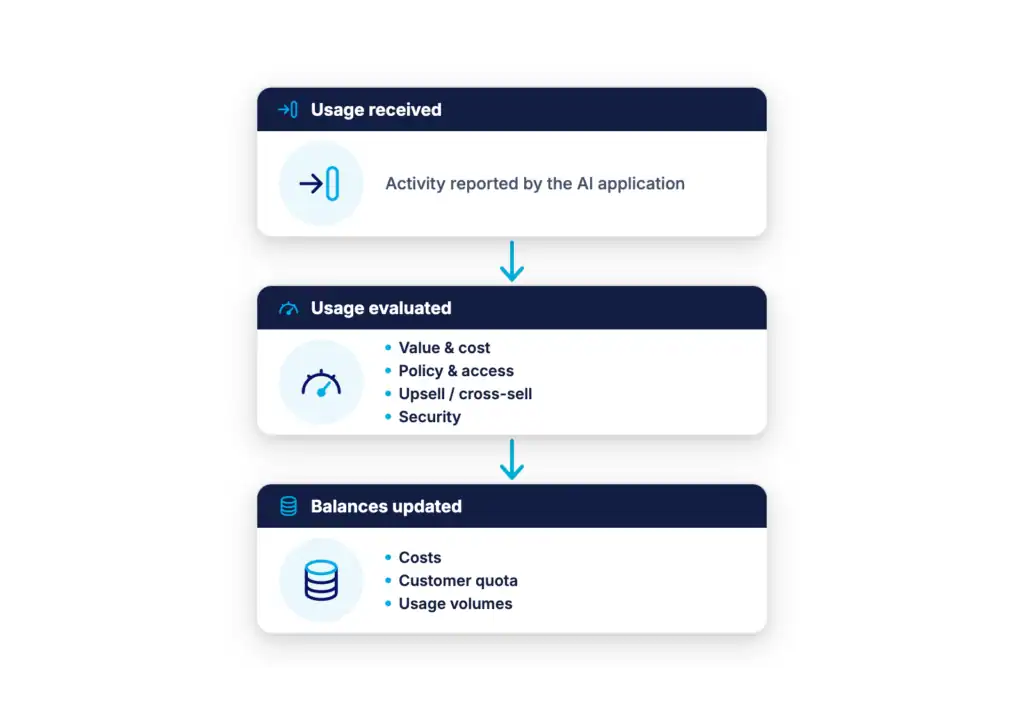
- Observe: Measure usage and calculate charges after consumption where retrospective reconciliation meets the commercial requirement.
- Enforce: Evaluate reported usage and trigger an action when a threshold is reached, accepting a minute defined delay before service enforcement takes effect.
- Authorize: Require approval and an allocation before work proceeds, with further authorization as the service consumes its allocation.
Expensive processing or concurrent agents sharing a prepaid balance may require authorization before further consumption.
Map the supporting commercial flow:
- Identify how usage reaches the commercial system and which decisions must return to the application or gateway.
- Establish where customer records, pricing, allowances, and balances are maintained.
- Separate responsibility for commercial decisions from responsibility for executing them.
- Assess which capabilities can be added alongside existing billing.
- For credits, define allocation, replenishment, expiry, sharing, and consumption rules where applicable.
- For outcome pricing, confirm the success criteria and the source of evidence.
Include what happens when records arrive late, appear twice, or cannot be processed. For controlled services, establish what the application should do if it cannot obtain a decision.
Output: A simple commercial flow showing the systems, responsibilities, and changes needed.
Decision to make: Can the existing architecture and commercial systems support the offer, and which specific gaps require integration, process changes or additional capabilities?
Days 61 to 90: Test one complete customer journey
Test the offer from service activity through to the customer bill. Use representative consumption and include situations that challenge the commercial rules.
A successful demonstration should show more than a correctly calculated price. It should establish whether the customer receives the agreed experience and whether the business can explain the resulting revenue and costs.
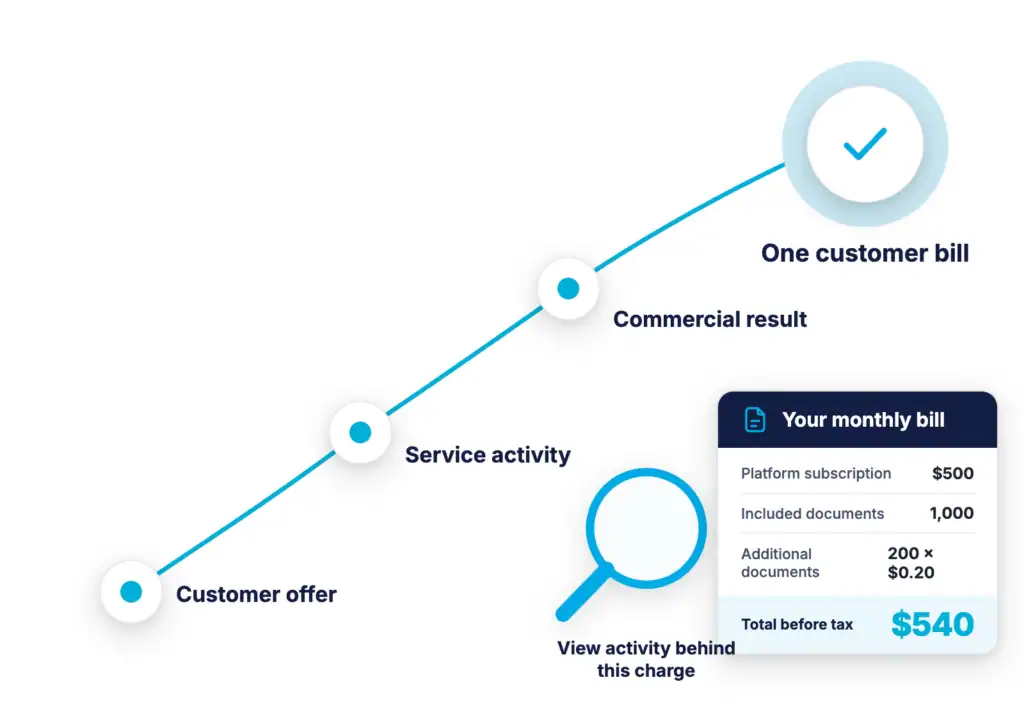
- Follow usage through measurement, customer attribution, pricing, and billing.
- Exhaust an allowance and confirm that the agreed notification, overage, or restriction occurs.
- Where authorization is required, test reservation, further authorization, settlementl, and release of unused balance.
- Check how failures, retries, and delayed records affect usage and charges.
- Ask a customer-facing colleague to explain the bill and trace a questioned charge to its supporting evidence.
- Compare revenue with allocated delivery costs and record any remaining uncertainty.
For near-real-time enforcement, measure the consumption that can occur before an action takes effect. For authorization, verify that the application stays within its approved allocation. These tests reveal whether the control model meets the offer’s actual requirements.
Output: A documented test result and a prioritized improvement log with owners.
Decision to make: Is the offer ready for a limited pilot, and what must be resolved before customers are exposed to it?
Turn the findings into an investment decision
At the end of the review, agree one of three next steps: close material information gaps, run a limited pilot, or implement the capabilities needed to support the offer.
For each investment, identify the commercial requirement it addresses. That might be launching pricing or packaging changes faster, preventing unauthorized consumption, explaining charges, or understanding delivery margins. Define an owner and measurable success criteria.
For revenue and product leaders, the result should be a defensible answer to four questions:
- Do customers understand what they are buying?
- Can the service operate within the agreed commercial boundaries?
- Can the business measure and charge for what it delivers?
- Do the economics support the proposed price and usage patterns?
This is a 90-day review and validation timetable.
Aria Billing Cloud for AI Monetization connects the Govern, Value, Act, and Bill capabilities behind AI-enabled offers. Bring your offer definition, representative usage and service architecture to a discussion with Aria to identify the foundations you already have and the capabilities you need next.
Review your AI monetization foundations with Aria – speak to an expert.