
AI monetization is not simply a billing challenge. It is an organizational and architectural one. Once an enterprise has decided to commercialize an AI-powered product or service, it has to connect a rapidly expanding number of decisions.
These decisions have traditionally been spread across Product, Finance, Commercial, Technology and Operations. AI makes separating them increasingly difficult.
- What exactly is the customer buying?
- How will consumption be measured?
- How does underlying AI cost translate into customer value?
- Which usage is included within a subscription, commitment or allowance?
- Who is authorized to consume it?
- What happens when consumption exceeds an agreed threshold?
- Should expensive activity be authorized before it occurs?
- And how does all of that ultimately become an accurate, understandable and auditable customer charge?
At the same time, the underlying technology environment is becoming more distributed. Applications and agents can interact with multiple foundation models, APIs, data sources and infrastructure services, increasingly through AI gateways that determine how requests are routed, governed and observed.
The commercial infrastructure has to connect into that environment too. That is why successfully monetizing AI requires more than choosing a pricing metric or adding usage billing to your billing stack.
Enterprises need a commercial operating model capable of governing consumption, determining its value, acting on it when necessary and ultimately billing for it. Aria Billing Cloud is aligned to this using its Govern. Value. Act. Bill. framework. More on this, later.
Article – AI MONETIZATION
Catch Up on the First Article in the AI Monetization Series
Our first article focuses on how enterprises need to rethink billing before AI products can scale commercially. It covers why token and usage models break legacy billing platforms, what capabilities AI-native monetization actually requires, and how to tell whether your current stack is a growth enabler or a constraint.

AI monetization crosses traditional organizational boundaries
Enterprise billing has traditionally sat relatively late in the commercial process. AI begins to blur those boundaries.
Consider an enterprise launching an autonomous customer-service agent.
- Product and Go To Market (GTM) teams might decide that customers should pay for successful resolutions or outcomes rather than users.
- Technology and Operational teams then have to determine how a resolution can be identified reliably and how the underlying AI activity should be instrumented.
- Finance teams needs to understand the inference, model, API and infrastructure costs required to produce that resolution and whether the resulting commercial model produces acceptable margins.
- Commercial teams need to determine whether customers will buy resolutions or outcomes individually, through credits, as part of a subscription, through an annual commitment or using some combination of these.
- Customer teams needs visibility into unusual consumption and potentially the ability to intervene.
- And Billing has to connect all of these decisions into one commercial relationship.
This means AI monetization cannot be designed independently by Finance, Product, GTM or Technology. The organization needs a common definition of what is being consumed, what constitutes value, how that value will be sold and the commercial rules governing its consumption.
Product and GTM team needs to define what the customer actually values
The first question for Product is deceptively simple:
What are we actually selling?
- A model provider may naturally measure tokens.
- An API business might count transactions.
- An AI agent might undertake hundreds of actions.
- A customer-service application might complete conversations.
- An autonomous software agent might complete entire workflows.
- And a business may ultimately want to charge according to an outcome produced by those activities.
These are very different commercial units. Product therefore has to distinguish between what can be measured technically and what customers perceive as valuable. That distinction matters because the underlying meter does not have to become the pricing metric.
- Twenty model calls, several API requests and thousands of tokens might collectively represent one completed workflow.
- Hundreds of agent actions might become one customer resolution.
- Different AI services might consume different amounts from a common pool of commercial credits.
While industrial-scale authorization, metering, mediation and rating are foundational, the technical consumption still has to be translated into commercial consumption.
- Product and GTM teams also need the freedom to experiment.
- One customer segment may prefer a predictable subscription containing an AI allowance.
- Another may prefer prepaid credits.
- A large enterprise might negotiate an annual commitment with usage-based overage.
- Another service may eventually support outcome-based pricing.
The commercial infrastructure underneath those propositions cannot require a new engineering project every time Product and GTM changes the packaging.
Product and GTM needs commercial optionality, not another hard-coded pricing model.
Finance needs to connect consumption, revenue and margin
The CFO sees a different problem. AI creates a much more direct relationship between customer activity and cost to serve. A service might consume foundation models, GPU resources, databases, APIs, retrieval services and other third-party infrastructure. Those costs can vary considerably between apparently similar interactions.
At the same time, the customer may not be paying for any of those underlying resources directly.
- They may be paying £1 for a workflow.
- Ten credits for an interaction.
- £20 for a completed resolution.
- Or an annual subscription containing an agreed amount of consumption.
Finance therefore has to understand both sides of the equation:
- What did it cost us to deliver?
- What did we charge the customer?
- What margin did the interaction generate?
This becomes even more important when models can be selected dynamically. An AI gateway might route one request to a relatively inexpensive model and another to a much more expensive model because of performance, availability, context or policy.
From the customer’s perspective, both requests may represent exactly the same service. From the provider’s perspective, their economics can be completely different.
Without connecting underlying consumption with the customer’s commercial agreement, a successful AI product can become an unprofitable one. Finance therefore needs more than accurate month-end billing. It needs visibility and controls around commitments, balances, credits, margin, unusual consumption, revenue leakage and financial exposure.
And for some AI services, those controls need to operate before the cost has already been incurred.
Technology and operations has to operationalize the commercial model at AI speed
For the CIO, CTO, COO and engineering organization, AI monetization creates a different set of requirements.
- Where does authoritative usage originate?
- How is an interaction associated with the correct customer, application or autonomous agent?
- How are potentially thousands of technical events correlated into a commercially meaningful transaction?
- Where are balances and entitlements maintained?
- How are commercial rules exposed back into the application environment?
And can all of this happen without compromising the performance of the AI service?
Traditional usage billing is predominantly retrospective. An event occurs. The usage record is captured. The event is mediated and rated. Eventually it becomes a charge. That model remains entirely appropriate for some AI services. But autonomous, highly variable or high cost AI creates another category of interaction where waiting until afterwards may be too late.
Before an economically significant action occurs, the application may need to know:
- Is this customer entitled to use the service?
- Is sufficient balance or allowance available?
- Has the customer reached a spending limit?
- Is this agent permitted to consume this resource?
- Should credits or capacity be reserved before execution?
- Should consumption continue, be restricted or be stopped?
And for long-running autonomous sessions, those questions may need to be asked repeatedly. These are no longer simply billing questions. They are runtime commercial decisions.
Commercial teams have to make AI understandable to customers
Sales and commercial teams face another challenge. AI pricing can become incomprehensible very quickly.
Tokens. Cache reads. Model invocations. GPU time. Vector queries. API requests. Agent actions. All of these may be perfectly legitimate technical measures of consumption. They do not necessarily make good customer propositions.
Commercial teams therefore have to translate the complexity of the underlying AI infrastructure into offers customers can understand, compare and budget for.
- Credits.
- Commitments.
- Allowances.
- Packages.
- Usage tiers.
- Service levels.
- Completed transactions.
- Or outcomes.
You will typically purchase model capacity using one unit, measure your overall service cost using others and sell value to customer using something else entirely. The technical meter measures what happened. The commercial model determines what it is worth. The monetization infrastructure needs to bridge those two worlds.
AI monetization also requires architectural interoperability
Getting the organization aligned solves only half the problem. The technology stack also has to work together.
A modern AI interaction can travel through several layers before any customer value is produced.
- A person or autonomous agent initiates a request.
- An enterprise application receives it.
- An AI gateway may route it.
- A foundation model processes it.
- Additional models, databases, APIs or agents may be invoked.
- Infrastructure is consumed.
- Telemetry is generated throughout that process.
Eventually, all of those technical interactions have to be associated with a customer and a commercial agreement.
Increasingly, AI gateways* or similar service enforcement point are becoming an important integration point in that chain.
* AI gateways can sit between applications and multiple model providers, providing capabilities such as model access, routing, fallback, observability and inline cost, usage and policy enforcement. Such platforms therefore may occupy an increasingly important position in the emerging AI architecture.
But the AI gateway or embedded service enforcement, and monetization platform solve different problems.
The gateway or service enforcement may know which model handled a request, how many tokens were consumed, how long the request took, whether another provider was used as a fallback and what the approximate underlying model cost was.
The monetization platform needs to know something different:
- Which customer does this belong to?
- What did they buy?
- What is included?
- What commitment applies?
- How should this activity be rated?
- Does it consume credits?
- Is it part of a shared allowance?
- Does an enterprise discount apply?
- Does the activity only become chargeable if an outcome occurs?
- And is the customer commercially authorized to undertake the next action?
That is why interoperability between the AI gateway/service enforcement and monetization environment becomes important.
The AI gateway/service enforcement understands the AI transaction.
The monetization platform understands the commercial relationship.
The two need to exchange information.
From AI telemetry to commercial intelligence with Aria
The first interaction between those environments is relatively straightforward.
AI Service → Usage Data (LLM Telemetry) → Aria Allegro → Aria Billing
The AI environment generates granular usage and runtime information, such as LLM Telemetry. Aria Allegro can capture, mediate and enrich that high-volume consumption, aggregate events (from multiple sources) into commercially relevant units, maintain accumulations and apply sophisticated rating.
The resulting commercial activity can then be incorporated into the wider customer relationship managed in Aria Billing Cloud by Aria Billing.
A single customer invoice might consequently contain:
- An annual or monthly platform subscription
- Included AI credits or allowance
- Consumption beyond that allowance
- Premium AI services
- API usage
- Outcome-based charges
- One-time products or services
- Negotiated enterprise discounts
That is one commercial relationship, rather than a collection of disconnected AI meters. AI monetization has to coexist with subscriptions, commitments, credits, account structures, discounting, invoicing, payments and the complete customer lifecycle.
But autonomous, highly variable or high-cost AI creates the potential for information to flow in the other direction too.
Commercial intelligence needs to flow back into the AI environment
Consider an autonomous agent about to execute an expensive workflow. The AI application knows what it intends to execute.
The commercial system knows whether the customer is entitled and able to pay for it. That creates another interaction:
AI Application → Authorization Request → Aria Allegro ACE → Commercial Decision → AI Application
Before the transaction occurs, Allegro ACE can evaluate the relevant commercial position.
- Does sufficient balance exist?
- Is the request within an allowance?
- Has a quota been exceeded?
- Does the customer have the required entitlement?
- Should an amount be reserved against future consumption?
If authorized, the transaction can proceed. As the session progresses, additional capacity can be requested and reauthorized. When the interaction finishes, actual consumption can be settled and unused reservations released.
This follows a commercial control loop of: Authorize → Reserve → Monitor → Reauthorize → Settle
Pre-authorization, balance reservation, allowance management, in-session charging and threshold-based actions allow billing to influence whether the next economically significant action should occur at all.
Connecting that capability with the AI application is significant. It means monetization no longer has to sit passively downstream waiting for usage records.
Commercial policy can become part of AI execution.
The Aria Commercial Loop
So the challenge is not simply to capture AI activity and eventually turn it into an invoice. Enterprises need to connect the commercial decisions that occur before, during and after consumption.
Aria Billing Cloud is aligned to this through its Govern. Value. Act. Bill. framework. It provides a practical way to think about the complete AI monetization lifecycle: establish the commercial rules governing consumption, translate technical activity into customer value, act on that information while it can still influence the economic outcome, and convert the resulting activity into an accurate and auditable financial relationship. This reflects the Aria model of moving from billions of digital events through governance, valuation and real-time action into billing and financial visibility.
Importantly, these are not four independent billing processes. They form a continuous commercial loop.
Govern establishes who or what can consume, how much they can consume, and the balances, commitments, entitlements and policies that apply.
Value determines what that consumption means commercially, transforming potentially billions of technical events into units, interactions, credits, outcomes or other measures customers can understand and buy.
Act uses that commercial intelligence to influence what happens next, from proactive agentic notifications and threshold actions to balance reservation, reauthorization or intervention while consumption is still taking place.
Bill brings the resulting activity into the customer’s complete financial relationship, creating the charge, maintaining the audit trail and providing the commercial evidence needed to inform the next cycle.
This last point is important. The framework is not a linear meter-to-invoice process that ends when the bill is produced. Billing creates new information about consumption, margin, customer behavior, commitments and outcomes. That information can feed back into the policies governing future consumption, how value is defined and the actions taken as the service operates.
Govern → Value → Act → Bill → Govern
For AI and autonomous services, that continuous loop is what turns billing infrastructure into a commercial operating system rather than simply a financial system of record.
Govern: establish the commercial rules before consumption
Before AI consumption can be monetized effectively, the enterprise needs to establish who or what can consume a service and under which conditions. Those conditions might be expressed through:
- monetary balances
- AI credits
- quotas
- included allowances
- contractual commitments
- departmental budgets
- API limits
- shared enterprise pools
- agent-specific limits
- product entitlements
Some controls can be reconciled after consumption. Others need to be checked before an expensive or autonomous action begins. Governance therefore has to be available as an operational service, not buried in contract documents or month-end processes.
The rules also need a clear owner. Product defines intended experience, Finance sets exposure and margin guardrails, Commercial agrees customer terms, Technology implements enforcement, and Operations monitors exceptions. Governance turns a commercial agreement into machine-readable policy.
Value: translate technical activity into a commercial unit
Once consumption is governed, the enterprise has to decide what that consumption is worth. That requires mediation between technical telemetry and customer value. Raw events may need to be validated, deduplicated, enriched with customer and product context, correlated into sessions, accumulated against tiers or commitments, and transformed into a commercial unit.
The resulting unit might be a token, interaction, image, minute, workflow, resolution, outcome or credit. The right unit is the one that creates a defensible connection between cost, value and the customer proposition.
This translation also protects commercial flexibility. Underlying models and costs can change without forcing every change directly into the customer-facing price. Different services can consume a common credit pool, and several technical events can become one billable outcome.
Value is where metering becomes monetization.
Act: turn commercial information into operational decisions
Commercial information has limited value if the enterprise and stakeholders cannot act on it.
Actions may be advisory: notify a customer that a threshold is approaching, alert Finance to deteriorating margin, or prompt an account team to discuss a larger commitment.
They may also be operational: reserve a balance, require top-up, apply a different route, throttle an agent, move work to a lower-cost model, prevent a disallowed service, or stop consumption altogether.
The action should reflect the product experience and the commercial agreement. A hard stop may be appropriate for prepaid capacity. A strategic enterprise customer might instead receive an alert and approved overage. A regulated workflow may require explicit authorization regardless of balance.
Acting at runtime closes the gap between knowing the commercial position and controlling the economic outcome.
Bill: bring AI into the complete customer relationship
The final step is to convert authorized and valued activity into an accurate, understandable and auditable charge. That charge cannot live in isolation. It must coexist with subscriptions, one-time products, commitments, discounts, taxes, payments, account hierarchies, revenue processes and the wider customer lifecycle.
The bill should explain the proposition the customer bought, not expose every internal implementation detail. Customers may need visibility into balances, credits, allowances, unit rates, overage and outcomes, with drill-down evidence available when questions arise.
Billing therefore completes the commercial loop. It creates the financial record, updates balances and commitments, supplies information for revenue and margin analysis, and provides new evidence that Product and Commercial teams can use to refine the offer.
Bill is not the end of the model. It is the feedback point for the next cycle of governance, value definition and action.
The operating model is a continuous commercial control loop
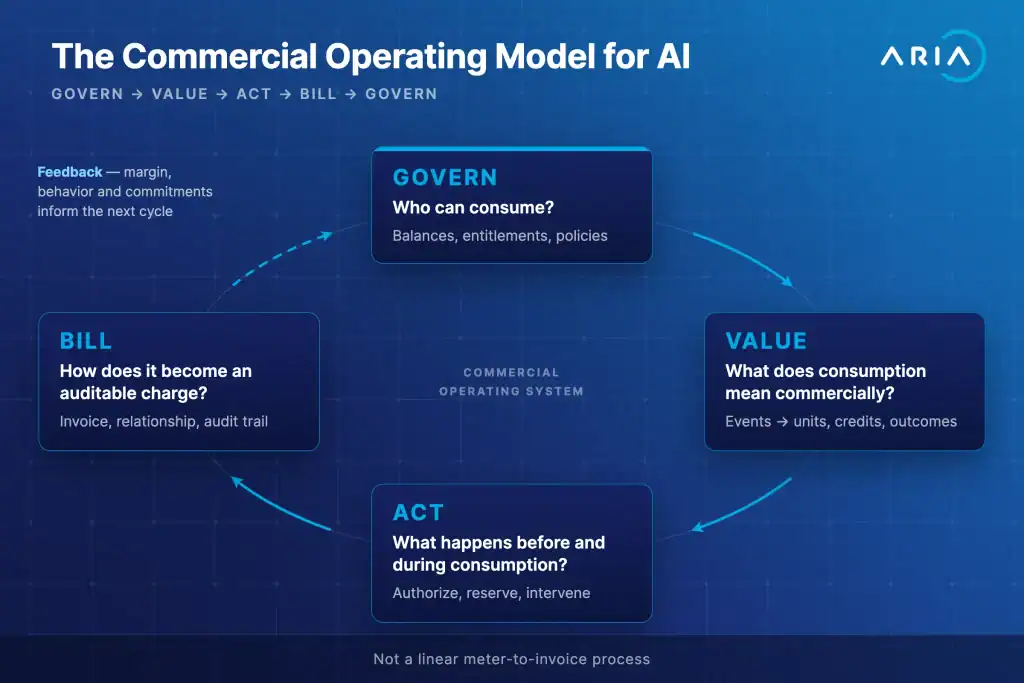
Govern, Value, Act and Bill should not be treated as four disconnected systems or sequential project phases. They form a continuous multi-directional commercial control loop:
- Govern who or what may consume and under which terms.
- Value technical activity in the commercial unit the customer buys.
- Act when balances, entitlements, budgets, thresholds or margin require intervention.
- Bill accurately within the complete customer relationship.
- Use the resulting data to refine the next offer, policy and decision.
This loop also creates a shared operating language across Product, Finance, Commercial, Technology and Operations. Each function retains its expertise, but decisions are connected through common commercial definitions and interoperable services.
AI monetization becomes an enterprise capability, not a billing-system configuration exercise.
Aria’s approach: connect the relationship, the usage and the runtime decision
Aria’s approach with Aria Billing Cloud brings together the layers required to operate this model.
Aria Billing manages the complete commercial relationship. It enables enterprises to combine recurring, one-time and usage-based charges with commitments, credits, discounts, account hierarchies, invoicing, payments and the wider customer lifecycle.
Aria Allegro provides the high-scale usage monetization layer beneath that relationship. It processes granular AI activity, mediates and enriches events, maintains accumulations, and applies the rating logic that turns technical consumption into commercial value.
Where consumption must be governed while it is occurring, Aria Allegro ACE adds real-time authorization, reservation, allowance and balance control. It can return commercial decisions to the application or AI gateway before and during economically significant activity.
Interoperability is central. AI applications and gateways can supply detailed transaction telemetry to Allegro and request commercial authorization from ACE, while Aria Billing maintains the wider customer, product and financial context.
Together, these capabilities support the full progression:
- Govern the consumption.
- Value the activity.
- Act on the commercial position.
- Bill within the complete customer relationship.
The result is not simply a better way to invoice AI. It is a commercial operating model capable of supporting AI as products, costs, customer expectations and autonomous behavior continue to evolve.
Enterprises need to build for whatever AI becomes next
AI is still early enough that designing around one definitive pricing model would be dangerous. The winning model will differ by industry, product, customer segment and stage of maturity. Tokens may remain important in some markets. Credits, commitments, workflows, resolutions and outcomes will matter in others. Most enterprise offers will combine several mechanisms.
What enterprises can predict with much greater confidence is that consumption will increase, autonomous activity will expand, model economics will keep changing and customers will demand greater clarity and control. That changes the monetization decision.
Enterprises should not build around today’s AI price list. They need commercial infrastructure that connects Product, Finance, Commercial, Technology and Operations, and that interoperates with the AI environment where consumption actually occurs.
They need to Govern the subscription and the consumption. Value the token and the workflow. Act for the human user and the autonomous agent. Bill the credit, the commitment, the usage and the outcome. And increasingly, they need to make commercial decisions at the speed at which AI acts.
That is the commercial operating model for AI.
Contact Aria to see how Aria Billing Cloud can help you build and operate an AI monetization model designed for what comes next.
