
For many communications service providers, the challenge is no longer simply replacing legacy billing costs. It is finding new sources of profitable growth in markets where subscriber growth has slowed, price competition remains intense, and new digital services must reach market far faster than traditional telecom operating models allow.
Today’s Communication Service Providers (CSPs) and partners need to launch far more than improved mobile and broadband plans. They need to monetize 5G and fiber services, IoT services, APIs, AI-powered offerings, digital content, enterprise platforms, marketplaces, and partner ecosystems, often combining traditional telecommunications revenue with entirely new business models.
At the same time, executive teams are under pressure to simplify complex BSS estates, reduce total cost of ownership, improve operational efficiency through AI, and protect margins. AI promises significant productivity gains across customer service, operations and revenue management, but only when deployed with strong governance, real-time controls, auditability and commercial accountability.
Unfortunately, existing billing/BSS platforms were designed for a very different era. They were built around highly structured monthly subscriptions, containing traditionally metered static products, and siloed B2C, B2B and wholesale business units. They struggle when operators want to introduce new pricing models, adopt AI efficiencies, launch services quickly, consolidate multiple billing systems following acquisitions, target new market categories or commercialize entirely new digital businesses – including monetizing new AI-native services.
The challenge is therefore much broader than replacing a billing engine. It is about creating a commercial platform that allows the business to experiment, launch, monetize and optimize new revenue opportunities while keeping operational complexity under control.
The program risk is equally important. Telecom CIOs and BSS leaders are no longer looking for another five-year transformation that simply recreates a legacy architecture in the cloud. They want modular cloud-native platforms that support phased modernization, coexist with existing OSS and BSS investments, integrate with AI-driven operations, and enable continuous commercial innovation without putting millions of subscribers at risk.
The market urgency is real. GSMA Intelligence reports that 40% of operators consider monetizing services beyond traditional connectivity products to be a major challenge. Increasingly, that challenge is less about the network itself and more about the commercial systems needed to price, monetize and manage new digital services.
This guide compares eight of the leading billing platforms CSPs should evaluate in 2026, from established telecom BSS vendors to modern cloud-native platforms, and explains which are best suited for improving market agility, enabling new business models, lowering operational costs and supporting the next generation of AI-enabled telecommunications.
Executive Summary
- Modern CSPs need billing platforms that support both traditional telecom services and emerging digital business models, including AI services, APIs, IoT, marketplaces, and partner ecosystems.
- The strategic objective has shifted from replacing legacy billing to improving market agility, accelerating product launches and creating new revenue streams while protecting margins.
- AI is becoming central to telecom operations, but operators require governed AI with usage controls, auditability, entitlement management and monetization built into the commercial platform.
- Reducing BSS complexity and total cost of ownership has become just as important as adding new functionality. Cloud-native architectures and phased migration approaches reduce program risk while improving operational efficiency.
- Telecom-grade billing platforms must support convergent charging, real-time monetization, ecosystem settlement, regulatory compliance and coexistence with existing OSS/BSS environments.
- Among SaaS-native providers, Aria Systems is one of the few platforms already supporting major CSPs including M1, Liberty Latin America, Comcast Technology Solutions, Telstra, TalkTalk Business and Telefónica UGG, while being recognized as a Leader by both IDC and Omdia and having strategic BSS portfolios and relationships with Salesforce and ServiceNow.
- Amdocs and Netcracker provide broad end-to-end traditional telecom BSS/OSS transformation capabilities via strong managed service propositions. Oracle adds to this with financial depth, accounts receivable and revenue management. Huawei combines carrier scale with an advanced services model, although procurement restrictions may exclude it in some markets. Cerillion offers a traditional integrated telecom BSS suite in a smaller, more product-led footprint for smaller CSPs.
- Zuora and BillingPlatform are credible options for enterprises focused on digital services, APIs, IoT and other subscription models. However, neither currently demonstrates customer or product credibility with native 3GPP compliance, prepaid/postpaid convergence or wholesale depth as a telecom-focused proposition.
- Require vendors to prove their claims using your expected products, event volumes, latency requirements, partner models and migration scenarios. The best platform is the one that enables profitable growth without allowing cost, implementation risk and operational complexity to grow at the same rate.
Use this guide to identify the platform best aligned with your priorities, whether that is faster service innovation, AI monetization/integration, BSS simplification, post-merger consolidation or long-term commercial transformation.
Vendor comparisons
Eight vendors, eight dimensions
The market includes two broad types of platform. Aria, Zuora and BillingPlatform are cloud-first SaaS platforms designed to support wider enterprise billing models. Amdocs, Netcracker, Oracle, Huawei and Cerillion are telecom-native vendors offering end-to-end BSS capabilities, including CRM, real-time charging, wholesale management and, in some cases, OSS.
This is not simply a choice between modern SaaS and legacy telecom software. Cloud-first platforms can offer faster deployment, greater commercial configurability and lower transformation risk, while telecom BSS suites provide traditional all in one business support systems and services. Some telecom-native vendors also offer lighter BSS suite SaaS products that can be deployed much faster than their full suites.
The comparison therefore uses seven dimensions reflecting the latest priorities of executives in the Revenue, Information, Finance, Product, Strategy, Technology and AI offices.
Comparing SaaS-native billing platforms
Criteria |
Aria Systems |
Zuora |
BillingPlatform |
Monetization breadth |
Aria Billing Cloud supports subscription, consumption, one-time, prepaid, postpaid, hybrid and outcome-based models. Its latest usage management engine, Aria Allegro, extends this to high-volume usage-based services, while Allegro ACE supports the real-time monetization and control of network, API, IoT and AI-native services. |
Supports subscription, usage, one-time and hybrid models. Strong outside telecom, but outcome-based pricing and telecom prepaid capabilities are not clearly evidenced. |
Supports usage, subscription and hybrid models across B2B and B2C. Outcome-based pricing and telecom prepaid capabilities are not clearly evidenced. |
Product and commercial agility |
Codeless product configuration and workflows allow business teams to create pricing, packaging, allowances, entitlements and personalized offers. Defined usage events and customer outcomes can be connected to pricing and contractual commitments without creating a separate billing platform for each service. |
Low-code/no-code pricing designer supports rapid price-plan iteration. |
Highly configurable data model and billing environment. Extensive customization can increase implementation complexity and make future changes harder to maintain. |
Real-time charging, control and convergence |
Aria Allegro processes and rates high volumes of usage records with sub-second speeds. Allegro ACE adds millisecond-response authorization, balance reservation, in-session accounting, threshold actions and dynamic entitlement enforcement. Together, they support online and offline charging across prepaid, postpaid, connectivity, digital and AI services. |
Usage metering at up to 200,000 records per second. Not purpose-built for telecom online charging, CDRs, in-session control or prepaid/postpaid convergence. |
Near-real-time ingestion of CDRs and events through its mediation engine. Carrier-scale online charging and convergent prepaid/postpaid control are not publicly demonstrated. |
Ecosystem and partner monetization |
Supports B2B2X, partner revenue sharing, commissions, supplier settlement and billing-on-behalf-of. Usage and outcome events can be attributed across customers, partners and sponsors. Interconnect settlement is provided through its iCONX partnership. |
Supports reseller and partner accounts, but has no published native wholesale settlement capability. |
Provides partner-program capabilities, but has no published native wholesale-settlement capability. |
Architecture and phased modernization |
Cloud-native billing and monetization layer designed to coexist with existing OSS/BSS investments. Integrations include Salesforce, ServiceNow, SAP, Oracle, NetSuite and mediation platforms. Allegro ACE exposes API and Diameter interfaces for integration with network, digital-service and AI environments. |
SaaS platform with Salesforce, HubSpot and NetSuite connectivity. Limited telecom charging, OSS and mediation depth. |
API-first SaaS platform with connectors for Salesforce, SAP, Oracle, NetSuite and Workday. |
Financial control and margin protection |
Native tax support, including VAT, GST and tax-on-tax. Real-time balances, reservations, thresholds, budgets and usage controls help prevent bill shock, uncontrolled consumption and margin erosion. SOC 2, GDPR and PCI DSS Level 1 compliant. Does not provide native accounts receivable. |
Strong revenue-recognition capabilities covering all five ASC 606/IFRS 15 steps, together with multi-currency, tax and broad payment connectivity. Real-time consumption and margin controls are not clearly evidenced. |
Provides ASC 606/IFRS 15 revenue recognition, tax, multi-currency and FX support, together with GDPR and PCI compliance. Real-time consumption and margin controls are not clearly evidenced. |
AI monetization, governance and automation |
Allegro can meter AI tokens, prompts, model calls, agent actions, workflows, API calls, vector queries and infrastructure consumption. Allegro ACE can authorize consumption and enforce budgets, quotas, entitlements, thresholds and policy rules in real time. Billie and Billie Connect provide a separate operational AI layer for customer-service assistance and agentic account actions. |
AI-consumption metering, real-time budget enforcement and agent-level commercial governance are not evidenced in the capabilities reviewed. |
AI-consumption metering, real-time policy controls and agent-level auditability are not evidenced in the capabilities reviewed. |
Delivery, TCO and operating model |
Single-codebase, public-cloud SaaS with codeless configuration, zero-downtime updates and several releases per year. Published delivery examples include Enet and Telefonica UGG in three months and M1 cloud-native BSS with Salesforce in nine months. |
Cloud SaaS, with a published telecom deployment in under 100 days. The scope of individual implementation claims should be confirmed. |
Cloud SaaS and API-first, but no typical implementation timeline is published. Extensive customization can increase professional-services costs and slow adoption of platform updates. |
Comparing telecom-native BSS vendors
Criteria |
Amdocs |
Netcracker |
Oracle Communications |
Huawei |
Cerillion |
Monetization breadth |
Supports mobile, fixed, 3G/4G/5G, IoT, prepaid, postpaid and B2B2X models. Outcome-based models are not specifically evidenced. |
Supports voice, messaging, data, IoT, 5G and XaaS services across consumer, enterprise and partner markets. |
BRM and Elastic Scale Charging support recurring, one-time and usage charges across B2C, B2B and B2B2X, including prepaid, postpaid, hybrid, 5G, IoT and partner-enabled models. Oracle supports value-based offers such as speed tiers and experience packs, but charging against measured customer business outcomes is not explicitly documented. |
CBS converges consumer, household and enterprise customers; human and IoT services; prepaid and postpaid; fixed, mobile, broadband, cloud and new digital services. It supports B2C, B2B and B2B2X, but outcome-based charging against measured business results is not explicitly documented. |
Supports prepaid, postpaid and IoT services. Outcome-based models are not specifically evidenced. |
Product and commercial agility |
Provides broad telecom product capabilities, but product changes sit within a larger services-led operating model. |
Provides extensive product and service management within a full BSS/OSS environment. |
Pricing Design Center provides a web-based business-user interface, reusable pricing components and multidimensional offers. Its flexibility is substantial, although more technically intensive configurations may still require specialist BRM skills and development. |
CBS uses AI-assisted offer design, customer personas and offer recommendations. Huawei says its Offering Design Agent can reduce package launch time from an industry average of three to four months to five days. |
Offers a pre-integrated suite and the smaller-footprint Skyline SaaS product. |
Real-time charging, control and convergence |
Real-time convergent charging benchmarked at 220 million subscribers, with sub-4ms latency for 99% of events. |
High-performance, 3GPP-conformant real-time charging across traditional and emerging services. |
Elastic Charging Engine provides a unified online and offline charging system for fixed and 2G-to-5G mobile networks. It supports prepaid, postpaid and hybrid accounts, real-time authorization, balance visibility, thresholds and spending controls through 5G Nchf, Diameter, REST and other network interfaces. |
CBS provides carrier-scale convergent charging, billing and settlement across 2G to 5G-Advanced, fixed services, B2C, B2B, B2B2X, human and IoT services. Huawei reports 99.9999% availability through its multi-active architecture, but does not publish directly comparable TPS or latency figures. |
3GPP convergent charging. A previous claim of more than 250 TPS per node and sub-50ms should be independently sourced or removed. |
Ecosystem and partner monetization |
Provides end-to-end partner lifecycle and settlement capabilities. |
Supports dynamic multi-partner settlement across B2B2X value chains. |
BRM provides configurable partner-settlement, revenue-sharing and remittance rules for B2B2X and multi-party models. Cloud Scale Charging supports different customer and partner hierarchies, sharing groups and payment structures. Native interconnect-settlement depth should be confirmed. |
CBS converges charging, billing and settlement and exposes more than 300 APIs to third-party and 5G partners. Huawei describes it as a partner-oriented platform, but detailed interconnect, commission and contractual revenue-sharing capabilities should be validated. |
Provides a dedicated Interconnect Manager for wholesale billing and settlement. |
Architecture and phased modernization |
Modular BSS/OSS with pre-integrated flows and TM Forum-aligned APIs. Supports cloud and hybrid deployment. |
Full-stack BSS/OSS, active mediation and partner management delivered through a SaaS model. |
BRM and ECE are available as on-premises or containerized cloud-native software. The cloud-native option uses Kubernetes, Helm and CI/CD tooling and can integrate with existing catalogs through TMF 620, REST APIs, SDKs and Kafka. It is deployable software rather than a fully managed multi-tenant SaaS service. |
CBS has a cloud-native architecture supporting gray releases, zero-interruption upgrades, multi-active disaster recovery and more than 300 APIs. Huawei reported that more than 20 CSPs had migrated to its cloud-native CBS by the end of 2022. |
Composable BSS/OSS. Diamond-level Open API certification at more than 50 APIs. |
Financial control and margin protection |
Provides multi-currency, taxation and broad compliance support. Detailed real-time margin and profitability controls should be confirmed. |
Provides native multi-currency, taxation and data-privacy support. Partner settlement enables multi-party financial control. |
Particularly strong financial depth. BRM covers billing, consolidated invoicing, taxation, payments, accounts receivable, collections, dunning, deposits, installments, general-ledger integration, revenue assurance and reporting. ECE adds real-time balance and spending controls. |
Converged billing, accounting and settlement can reduce duplication and support unified customer balances. Huawei claims CBS can reduce TCO by 30%, but published detail on taxation, revenue recognition, receivables and offer-level margin accounting is less extensive than Oracle’s and should be evaluated by jurisdiction. |
Supports multiple tax schemes and wholesale settlement. Detailed revenue-recognition and margin controls should be confirmed. |
AI governance and automation |
Positioned as an AI-driven BSS/OSS platform. Granular AI metering, budget enforcement and consumption auditability should be evaluated. |
Provides AI-driven transformation capabilities. Specific AI-consumption and commercial-governance controls should be confirmed. |
Oracle Monetization Suite 15.2 introduces AI microservices for predictive use cases such as product, bundle and offer recommendations. Oracle currently labels this framework experimental. ECE can rate configurable usage metrics and apply real-time spending controls, but packaged metering and governance for tokens, prompts, models and agent actions are not explicitly documented. |
Strong AI-assisted billing operations. CBS includes offer design, bill-run management, invoice, dispute-resolution, dunning and payment agents, plus intelligent O&M and fault recovery. However, Huawei does not explicitly document runtime metering and budget enforcement for AI tokens, models, workflows or individual agent actions. |
AI metering, real-time AI policy control and agent-level auditability are not evidenced in the capabilities reviewed. |
Delivery, TCO and operating model |
Full-suite deployments are generally large, services-led programs lasting 12 months or more. |
Full transformations are typically multi-year and services-intensive. |
Cloud-native packaging improves deployment automation, but BRM/ECE remains a substantial, operator-configured platform requiring database, Kubernetes, charging and BRM expertise. No standard implementation timeline is published. It is best suited to CSPs prepared to operate or outsource a strategic billing platform. |
Huawei reports deployments supporting 2.3 billion subscribers and 600 million IoT users across more than 200 CSPs, with a SaaS delivery model introduced in Europe. However, deployments remain services-led and no standard implementation timeline is published. Regulatory, national-security and procurement restrictions can remove Huawei from consideration in some markets. |
Skyline may launch in approximately three weeks. A full BSS/OSS deployment requires a longer program. |
1. Aria Systems
What it is. Aria is a true cloud-native billing, charging and monetization platform built for the complexity of telecoms and large enterprises. The Aria Billing Cloud portfolio includes Aria Billing for recurring billing and order-to-cash, Aria Allegro for high-volume usage processing and Allegro ACE for real-time authorization and in-session charging control.
Aria is not a complete OSS/BSS suite. It provides the commercial and monetization layer that integrates with a CSP’s existing CRM, OSS, BSS and enterprise platforms. This makes it particularly relevant to operators that want to modernize billing incrementally via a composable architecture as promoted by the TM Forum rather than replace their entire technology estate at once.
Telecom customers. Publicly disclosed deployments include Bell Canada, M1, Liberty Latin America, AT&T Gigapower, EXA, Comcast Technology Solutions, Rev, Superloop, Telstra, TalkTalk Business and Telefónica UGG.
Analyst recognition. Aria has been named a Leader by independent analyst firms, including IDC and Omdia, for enterprise-focused subscription and usage management. Aria holds TM Forum Open API Conformance Certification at Gold level and won TM Forum Catalyst Awards for every year in the last 5 years.
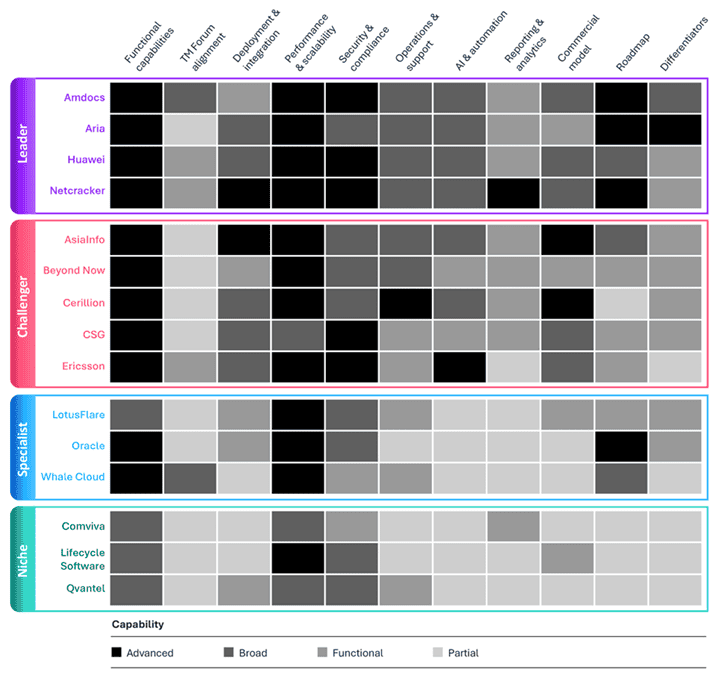
Figure: Omdia considers Aria a billing leader in telecoms.
Reference: Omdia Telecom Billing Market Radar 2025
Why it stands out for CIOs. Aria provides a SaaS billing, charging and monetization layer that can operate alongside the rest of the CRM/OSS/BSS estate. CSPs can migrate selected products, customer groups or business units without committing to a full-suite transformation or recreating a legacy architecture in a hosted environment.
The platform runs on a single codebase with several releases each year, avoiding customer-specific upgrade branches. Pre-built integrations cover Salesforce and ServiceNow, with connectors for ERP platforms including SAP, Oracle and NetSuite, as well as mediation and other OSS/BSS systems.
Why it stands out for CROs and CPOs. Aria Billing Cloud supports subscription, consumption, one-time, prepaid, postpaid, hybrid and outcome-based commercial models. Business teams can configure pricing, packaging, discounts, commitments, allowances and entitlements using codeless tools and workflows.
This allows CSPs to combine connectivity with devices, content, cloud services, APIs, AI capabilities and third-party products. It also enables reported customer outcomes, such as completed transactions, achieved service levels or resolved interactions, to be connected to pricing and contractual commitments.
Why it stands out for CTOs. Allegro and Allegro ACE extend the platform beyond conventional telecom usage charging. Allegro processes and rates any volume of network, application, API, IoT and digital-service usage, making rated records available in near real time.
Allegro ACE provides the online charging and control capabilities of any service before and during consumer usage. It supports pre-authorization, balance reservation, in-session accounting, threshold actions and dynamic entitlement enforcement with millisecond response times. API and Diameter interfaces allow it to connect with both telecom network environments and newer digital-service architectures.
Together, Allegro and Allegro ACE allow CSPs to combine online and offline charging across traditional connectivity and emerging services while maintaining consistent balances, entitlements and commercial controls.
Why it stands out for Chief AI Officers: Aria addresses both sides of the Chief AI Officer’s billing requirement: governing and monetizing AI consumption, and enabling enterprise AI systems to use billing intelligence and functions to improve operations.
On the consumption side, Allegro allows CSPs to meter AI usage at the level required for commercial accountability. Measurable units can include tokens, prompts, model calls, agent actions, workflows, API calls, vector queries and underlying infrastructure consumption.
Allegro ACE adds real-time control by authorizing consumption before it occurs and applying budgets, quotas, entitlements, thresholds and policy rules during execution. A CSP can identify which customer, user, application or AI agent generated a cost, determine whether the consumption is permitted, and stop or modify activity before commercial exposure becomes unacceptable.
These capabilities allow CSPs to control the cost of AI used within their own operations and monetize AI-native services offered to customers and partners. They also support prepaid, committed-use, consumption-based, sponsored, hybrid and outcome-based AI propositions.
On the operational side, Billie Connect gives AI assistants and agents governed access to Aria’s billing data and functions via MCP and A2A. Through secure APIs and agent-oriented interfaces, enterprise AI systems can retrieve information such as balances, usage, entitlements, invoices, payments and account history. Subject to permissions and policy controls, they can also initiate approved billing and account-management actions.
This allows billing intelligence to be used from customer-care, CRM, collaboration and other enterprise platforms, supporting use cases such as bill-shock prevention, dispute resolution, collections, dunning, revenue assurance, churn management and personalized offers. AI agents can act within the systems where employees and customers already work rather than requiring every interaction to begin inside the billing application.
Auditability applies across both sides. The CSP can trace which customer, employee, application or AI agent consumed a service, accessed billing information or initiated a commercial action. Allegro and Allegro ACE make AI consumption measurable and financially controllable, while Billie Connect makes billing intelligence and capabilities available to AI-driven operations within governed boundaries.
These capabilities complement rather than replace responsible-AI, model-risk, privacy and cybersecurity controls. Their role is to connect AI consumption and agent activity to real-time commercial controls, trusted billing data and accountable operational actions.
Partner and wholesale monetization. Aria supports partner revenue sharing, channel and sales commissions, and transaction-linked settlement across subscription, usage-based and deal-specific contracts. It also supports billing-on-behalf-of for MVNA and MVNE models. Interconnect wholesale settlement is provided through Aria’s partnership with iCONX rather than natively within Aria Billing Cloud.
Operational AI. Aria Billie and Billie Connect address different points to operational AI. Billie provides conversational assistance for customer-service, product management and operational assurance representatives from within Aria Billing Cloud, while Billie Connect supports agentic actions and services against customer accounts to external applications via A2A and MCP.
Proven delivery outcomes. M1 delivered a cloud-native BSS MVP in nine months, while UGG went live with Aria Billing Cloud and ServiceNow in three months. Its pre-integrations with Salesforce and ServiceNow to form a complete BSS suite have reported to deliver 300% faster time-to-market and a five-month time-to-value for many operators. That result applies to the combined solution rather than Aria alone.
Operational efficiency. Aria’s automation, codeless workflows and single-codebase SaaS model are designed to reduce manual work, specialist dependency and upgrade overhead. Real-time usage controls combined with AI agents can also help CSPs prevent bill shock, revenue leakage and unprofitable consumption as they expand into higher-volume digital and AI services.
Considerations. Aria Billing Cloud is public-cloud only, with no on-premise or private-cloud deployment option (except for its Aria Allegro/ACE usage processing engine), and it does not provide native accounts receivable. Aria is also a pure and focused billing, charging and monetization platform rather than a complete OSS/BSS suite, so CSPs seeking a single vendor to replace the entire estate may prefer one of the broader telecom incumbents.
2. Zuora
What it is. Zuora is an enterprise monetization platform covering quote-to-cash, subscription management, payments, collections and revenue recognition. It’s been highly associated with the “subscription economy” supporting many thousands of small and medium enterprises who’ve switched on subscription models.
Zuora remains more closely aligned with enterprise software, cloud, media and digital-service businesses than traditional telecom BSS.
Key features. Zuora supports one-time, recurring, consumption up to 200,000 records per second, committed-use and hybrid models. It provides drag-and-drop metering configuration, near-real-time rating, balance and threshold visibility, detailed usage audit trails and automated flows from usage through billing and revenue recognition.
Zuora Revenue automates all five stages of ASC 606 and IFRS 15, including performance obligations, standalone selling-price allocation, contract modifications and audit-ready reporting. Integrations include Salesforce, SAP, Workday and NetSuite.
Strengths. Zuora is one of the strongest platforms in the comparison for enterprise product innovation and financial control rather than telecoms. It allows product teams to introduce subscription offers while giving finance teams traceability from usage events to invoice and recognized revenue.
AI monetization and automation. Zuora launched an AI Monetization Suite in 2026 to help companies model and commercialize AI products. It supports metrics such as tokens, API calls, model runs, workflows and credits, together with prepaid drawdown, commitments, top-ups, thresholds and overages.
Zuora AI also introduces agents and MCP-enabled workflows across quote-to-cash. These operate within existing financial permissions, controls and audit frameworks, helping finance and revenue-operations teams automate pricing, billing, collections and analysis.
Considerations. Zuora’s real-time usage capabilities should not be confused with a telecom online charging system. It can ingest, meter, rate and report consumption rapidly, but it does not publish native 3GPP charging-function support, Diameter integration, in-session balance reservation or network-level service authorization.
It also does not provide true prepaid/postpaid telecom convergence or native interconnect and wholesale settlement. Zuora is therefore a strong candidate for digital services, enterprise platforms, IoT, APIs and AI propositions, but not a complete replacement for a carrier charging and billing estate supporting core mobile services.
3. BillingPlatform
What it is. BillingPlatform is a cloud-based, multi-tenant usage-to-cash and revenue-management platform supporting B2B and B2C business models. Its architecture combines metering, mediation, rating, billing, payments, collections and revenue recognition on a configurable metadata-driven model.
Customers include organizations such as J.P. Morgan Payments, CCC Intelligent Solutions, Instacart, ResMed, CooperSurgical and Amadeus. It is designed for businesses that need more flexibility than a conventional subscription-billing application but do not necessarily require a telecom-native BSS suite.
Key features. BillingPlatform supports subscription, usage-based, hybrid and consumption models. Its native mediation capabilities collect, validate, normalize and deduplicate data from APIs, webhooks, event streams, files and CDR sources before passing events to the rating engine.
The platform provides configurable pricing and billing rules, accounts receivable, collections, payments and automated revenue recognition. Its revenue-recognition module supports performance obligations, standalone selling prices, contract modifications, revenue schedules and ASC 606/IFRS 15 reporting. Pre-built integrations include Salesforce, SAP, Oracle, NetSuite and Workday.
Strengths. BillingPlatform’s principal strength is configurability across the revenue lifecycle. Its unified data model allows organizations to adapt products, pricing, contracts, invoices and revenue rules to complex requirements without assembling multiple independent billing products.
This makes it relevant to CPOs and CROs introducing unusual commercial models, as well as CFOs seeking a connected flow from usage event to journal entry. Its mediation capabilities also make it more suitable for high-volume IoT, cloud, communications and digital-service scenarios than lightweight subscription-management tools.
AI monetization and automation. BillingPlatform now positions the platform as AI-native rather than simply AI-assisted. Its AI operates against the live metadata model spanning metering, billing and revenue recognition. It can analyze the revenue lifecycle and configure pricing tiers, usage thresholds, contract rates and new monetization structures through natural-language interaction, subject to approval and existing permissions.
The platform also exposes MCP, A2A and agent-callable services, allowing enterprise AI tools and autonomous agents to access billing data and workflows. BillingPlatform states that it supports AI-native consumption and outcome-based business models.
Considerations. BillingPlatform’s AI proposition focuses primarily on configuring and operating the revenue platform. Published material does not establish Aria Allegro ACE-equivalent capabilities for authorizing an AI action before execution, reserving balances during a session or stopping consumption immediately when a budget or policy threshold is reached.
Its mediation engine can process telecom CDRs and near-real-time events, but BillingPlatform does not publish carrier-scale online charging benchmarks, native 3GPP charging-function support, Diameter interfaces or a convergent prepaid/postpaid charging model. Native interconnect and wholesale-settlement depth is also not publicly demonstrated.
The platform’s flexibility can introduce governance and maintenance challenges if an implementation becomes heavily customized. Buyers should distinguish between declarative configuration that remains on the standard platform and bespoke development that increases services cost and complicates future changes.
4. Amdocs
What it is. Amdocs is a telecom-native software and services company providing charging, billing, revenue management, customer experience, catalog, partner management and broader OSS/BSS capabilities. Its customers include many of the world’s largest communications providers, including T-Mobile, AT&T, e&, Telefónica Germany, A1 Telekom Austria, PLDT and Three UK.
Amdocs is best viewed as a strategic telecom transformation provider rather than a standalone billing-software vendor. It combines product platforms, systems integration, transformation services and managed operations.
Key features. Amdocs Charging is a cloud-native, 5G-ready convergent charging platform supporting online and offline charging across prepaid, postpaid, fixed, mobile, IoT and digital services. It provides real-time rating, quota allocation, spending visibility and network integration across 4G and 5G environments. Its history is based on its own developments plus recent acquisitions of Openet and Matrixx.
CatalogONE allows business users to create and launch multi-sided offers through a unified commerce and monetization catalog. MarketONE manages the lifecycle of third-party digital-service partners, while the wider revenue-management portfolio supports partner monetization, settlements, B2B2X and API-based business models.
Amdocs also offers Freestyle Billing and ConnectX for more modular, cloud-native and SaaS-oriented deployments, although these products differ significantly in scope from a full Amdocs BSS transformation.
Strengths. Amdocs provides some of the deepest carrier-scale charging, billing and ecosystem-management functionality in the comparison. It is particularly strong where a CSP requires 3GPP-aligned real-time charging, prepaid/postpaid convergence, network slicing, complex enterprise propositions and multi-party settlement.
Its broad portfolio can address the priorities of almost every executive persona, from real-time network monetization for the CTO to partner growth for the Chief Strategy Officer and revenue assurance for the CFO.
AI monetization and automation. Amdocs has expanded from AI-assisted operations into agent-driven BSS through amAIz, CES26 and its aOS agentic operating system. Its agents span customer care, sales, catalog, billing, revenue assurance and network operations.
Amdocs AI Factory also integrates the Amdocs monetization portfolio’s metering, rating and charging capabilities to support commercial models for AI services. However, its public material provides less detail than Aria on the specific metering of tokens, prompts, models, workflows and individual agent actions or on the real-time enforcement of per-agent budgets and entitlements.
Considerations. The breadth of the Amdocs portfolio comes with significant transformation weight. Core charging, billing and catalog programs are usually large, services-led initiatives involving extensive integration, migration and operating-model change and costs that many CSPs no longer find feasible.
Amdocs supports phased modernization and offers more modular products, but buyers must distinguish between the deployment characteristics of ConnectX, Freestyle Billing or MarketONE and those of the full revenue-management and BSS portfolio. For CSPs prioritizing a lightweight billing layer, rapid coexistence and predictable evergreen SaaS upgrades, Amdocs may be more services oriented than the requirement demands.
5. Netcracker
What it is. Netcracker provides cloud-native BSS, OSS, charging, revenue-management, partner-management and service-orchestration platforms for communications providers. Customers include T-Mobile, KDDI, Swisscom, TELUS, Telefónica, Cox Communications, Google Fiber, Vodafone and Zain.
Like Amdocs, Netcracker is a broad telecom transformation provider rather than a billing-only vendor. Its portfolio can support the commercial, customer and network layers of a CSP’s operating environment.
Key features. Netcracker Convergent Charging System (CCS) is a cloud-native, dynamically scalable, 3GPP-conformant platform supporting real-time charging across 4G, 5G and emerging digital services. It can charge using network and service attributes such as latency, throughput, location, mobility and network-slice utilization. It also supports API-call charging, prepaid, postpaid, hybrid services and distributed deployment of latency-sensitive charging functions at the edge.
Revenue Management covers usage management, charging, billing, debt collection and financial relationships across customer types and lines of business. Partner Ecosystem Management and Digital Marketplace support partner onboarding, B2B2X, revenue sharing, sponsored services and multi-party settlement.
Strengths. Netcracker is particularly strong for CSPs seeking to connect commercial innovation directly to network capabilities. Its support for API invocation, dynamic network slicing, SLA-related attributes and multi-partner propositions makes it relevant to 5G, Network-as-a-Service, private-network and cross-industry ecosystem models.
Its CCS can run on Kubernetes-compatible public, private or hybrid clouds, including AWS, Google Cloud and Microsoft Azure, and can be offered through a SaaS model. This provides more deployment flexibility than traditional on-premises charging platforms.
AI governance and automation. Netcracker’s Agentic AI Solution embeds agents into CPQ, product catalog, customer engagement, resource inventory and service orchestration. Each Digital BSS/OSS component includes an MCP server, and the platform supports third-party agents, different LLMs and emerging A2A integration.
Its AI Trust & Control layer provides orchestration, access controls, audit trails, explainability, observability and policy guardrails. This is one of the strongest responsible and operational AI-governance propositions among the telecom incumbents.
However, Netcracker’s published AI governance focuses on how agents access data, tools and operational systems. It does not explicitly describe metering AI tokens, model calls and individual agent actions for billing, or enforcing real-time commercial budgets for those units. These requirements would need to be validated separately.
Considerations. Netcracker’s full BSS/OSS portfolio is a heavyweight, services-led proposition. Although individual components can be deployed incrementally and CCS is available in a SaaS model, complete transformations may still span several years.
The suite is most compelling where a CSP wants close integration between charging, commerce, customer management, partner ecosystems and network orchestration, as a full BSS suite. It may be unnecessarily broad where the immediate need is a modular billing and monetization layer that coexists with established or more modern CRM, ERP and OSS investments.
6. Oracle Communications
What it is. Oracle Communications Billing and Revenue Management is a full-stack charging, billing and revenue-management platform for communications and digital-service providers. BRM manages product and pricing, customer accounts, billing, invoicing, payments, receivables, collections and revenue assurance. Elastic Charging Engine provides the high-scale online and offline charging layer.
Oracle is therefore broader than most billing-first SaaS platforms but narrower than a complete BSS/OSS transformation suite. It is most relevant to CSPs seeking deep telecom charging combined with comprehensive financial operations.
Key features. Oracle ECE provides convergent online and offline charging across fixed and 2G-to-5G mobile networks. It supports session- and event-based charging, prepaid, postpaid and hybrid accounts, real-time balance management, spending limits and network integration through 5G Nchf, Diameter, REST and other interfaces.
Pricing Design Center supports recurring, one-time and usage charges, with reusable components and rating dimensions based on volume, tier, time, location and other attributes. BRM also supports customer and account hierarchies, shared balances, entitlements, partner settlements and B2B2X models.
Strengths. Oracle’s biggest advantage is its financial completeness. Unlike platforms that stop at billing and invoicing, BRM includes payments, native accounts receivable, collections, dunning, deposits, installments, taxation, general-ledger integration, revenue assurance and reporting.
This makes Oracle particularly relevant to CFOs and CIOs seeking a strategic revenue-management platform rather than a narrower billing layer. Its support for both on-premises and cloud-native deployment also gives operators more infrastructure choice than public-cloud-only SaaS platforms.
AI capabilities. Oracle Monetization Suite 15.2 introduces AI microservices that integrate with BRM and ECE. The initial documented use cases focus on predictive analytics and product, bundle and offer recommendations. The framework is extensible but is currently described by Oracle as experimental.
ECE can rate configurable usage events and enforce real-time balances and spending limits. It could therefore be adapted to AI-related usage, but Oracle does not currently document packaged controls for tokens, prompts, model calls, workflows or agent actions comparable to Allegro and Allegro ACE.
Considerations. Oracle BRM is a mature and technically powerful platform, but that depth creates implementation and operating complexity. Cloud-native BRM is containerized software deployed through Kubernetes and Helm, not a fully managed multi-tenant SaaS service.
CSPs should expect specialist BRM, ECE, database and integration skills, particularly where the implementation includes extensive customization or migration from an older Oracle estate. Oracle is strongest when the requirement justifies a comprehensive billing and financial-control platform. It may be disproportionately heavy for a CSP seeking a modular monetization layer that can be introduced rapidly alongside existing systems.
7. Huawei
What it is. Huawei’s Convergent Billing System (CBS) is a telecom-native, cloud-native charging, billing and settlement platform designed for large communications service providers. It converges consumer, household and enterprise customers; prepaid and postpaid; human and IoT services; and fixed, mobile, broadband, cloud and emerging digital services.
Huawei reported that CBS supported 2.3 billion subscribers and 600 million IoT users across more than 200 CSPs in over 110 countries by the end of 2022.
Key features. CBS provides convergent charging, billing, accounting and settlement across network generations from 2G to 5G-Advanced. It supports B2C, B2B and B2B2X services, unified customer balances and a converged “one bill” experience.
Its cloud-native architecture supports gray releases, zero-interruption upgrades, multi-active disaster recovery and automatic switchover. Huawei reports availability of 99.9999% and provides more than 300 APIs for integration with partners and third-party services.
Strengths. Huawei combines extreme telecom scale with deep convergence and a strong network heritage. It is particularly competitive for operators that already use Huawei network and BSS technology or want a single platform spanning charging, billing and settlement.
Huawei is also one of the strongest vendors in the comparison for AI-assisted commercial and billing operations. Its Offering Design Agent uses natural-language and data-driven capabilities to automate offer configuration. The platform also includes intelligent bill-run management, invoicing, dispute resolution, dunning, payments, operations and fault recovery.
AI capabilities. Huawei’s AI proposition is primarily about accelerating offer creation, improving personalization and automating billing operations. This is relevant to the CPO, CIO and CFO because it can reduce manual effort and shorten product-launch cycles.
However, this should not be confused with governing the consumption of AI services themselves. Huawei does not explicitly document granular metering of tokens, prompts, models, workflows and agent actions or the application of real-time budgets and policy controls to those units. That remains an important distinction from Aria’s Allegro and Allegro ACE proposition.
Considerations. Huawei implementations remain large, strategic and services-led, despite the availability of cloud-native and some SaaS delivery options. Detailed public information about standard delivery times, country-specific taxation, financial accounting and partner-settlement models is limited and should be validated during evaluation.
Huawei also presents a procurement issue that is separate from product capability. The UK requires Huawei equipment to be removed from 5G networks by the end of 2027, while the US FCC includes Huawei telecommunications equipment and services on its Covered List. These restrictions do not automatically determine the treatment of every standalone BSS deployment, but they create material security, legal and procurement risks for CSPs in affected markets. UK government position US FCC Covered List
8. Cerillion
What it is. Cerillion is a telecom-native provider of a BSS suite covering customer management, product catalog, charging, billing, payments, receivables, service fulfillment, mediation, and network inventory.
Its customers include Sure by Beyon, C&W Communications, Manx Telecom, GO, Gibtelecom, SWAN Mobile, Vocus, Norlys and 1Global. Cerillion reports approximately 70 implementations across around 45 countries, giving it a meaningful international footprint while remaining considerably smaller than Amdocs, Netcracker, Oracle and Huawei.
Key features. Cerillion Convergent Charging System provides unified online and offline charging through a single 3GPP-compliant platform. It supports prepaid, postpaid and hybrid services, multiple monetary and non-monetary balances, shared allowances, network slicing and session- and event-based charging.
The platform provides real-time authorization, accounting, balance reservation, policy control and customer spending controls. Network interfaces include 5G Nchf using JSON/HTTP2, Diameter and SS7/CAMEL, making it a genuine telecom charging platform rather than simply a high-volume usage-rating engine.
Revenue Manager provides billing and revenue management across mobile, fixed, cable and multi-play services. Mediator Plus supports online and offline usage, while Interconnect Manager provides wholesale billing and settlement. Cerillion also supports partner billing and revenue sharing through its wider business-partner capabilities.
Product and commercial agility. Cerillion Enterprise Product Catalogue allows business users to create and manage products, tariffs, allowances, packages and promotions centrally and publish them to Cerillion or third-party systems.
The catalog now includes GenAI-powered agents that translate natural-language product ideas into structured configurations, identify dependencies and conflicts, simulate promotional impact and generate approval-ready changes. Product configurations remain versioned, governed and auditable before publication.
Strengths. Cerillion’s main competitive advantage is that it combines genuine telecom charging and BSS/OSS depth with a smaller, pre-integrated and product-led footprint. It offers more native network charging, mediation and wholesale functionality than billing-first SaaS platforms while potentially being less organizationally and commercially heavyweight than the largest telecom incumbents.
It is particularly relevant to mid-sized operators, MVNOs, regional CSPs, fiber providers and digital brands that want a traditional integrated telecom platform without undertaking a Tier-1-scale transformation.
Cerillion has strengthened its standards position. In March 2026 it achieved TM Forum Open API certification. Cerillion’s CRM Plus, Enterprise Product Catalogue and Service Catalogue also form part of its alignment with TM Forum’s Open Digital Architecture.
AI governance and automation. Cerillion has developed an operational AI Hub that includes Catalogue, Promotions, Sales, Workflow and Billing agents, together with AI-powered analytics and anomaly detection.
These agents can collaborate with approved third-party agents through MCP and A2A. Cerillion provides scoped permissions, policy controls, human approvals, audit trails and an AI Management Centre to govern access to data and operational actions. The architecture is designed to work with different LLMs, including ChatGPT, Claude, Gemini and Azure AI.
However, Cerillion’s current AI proposition primarily focuses on using AI to operate and automate BSS/OSS. Although its charging engine can accept transactional events through APIs and could potentially rate AI-related usage, Cerillion does not explicitly document packaged metering of tokens, prompts, model calls, workflows and individual agent actions or ACE-equivalent real-time budget enforcement for those units.
Delivery and operating model. Cerillion offers modular and end-to-end deployment, public or private cloud, on-premises software, managed services and SaaS. Its common-product approach is based on configuration rather than maintaining heavily customized customer-specific branches.
Cerillion’s current published position is that a managed service can be established from three weeks, while a complete end-to-end Cerillion Express deployment starts from approximately ten weeks. Full enterprise BSS transformations take longer and depend on migration and integration scope.
Considerations. Cerillion does not publish a current charging-volume or latency benchmark directly comparable with the largest Amdocs or Oracle deployments. They are also considered to offer the quintessential traditional BSS suite for smaller scale CSPs.
Cerillion’s smaller scale can be an advantage for CSPs seeking direct access, responsiveness and a less bureaucratic vendor relationship. It can also mean a smaller implementation ecosystem, fewer global systems-integrator resources and fewer reference deployments at the most extreme Tier-1 scale.
Buyers should also distinguish among Cerillion Skyline, Cerillion Express, individual modular products and the complete enterprise BSS/OSS suite, since their implementation scope, delivery times and operating models differ substantially.
How to choose a telecom billing platform
Choosing a telecom billing platform is no longer simply a technology decision. You are selecting the commercial infrastructure through which you will launch new services, control consumption, manage partners, protect margins and grow beyond traditional connectivity.
Use the following questions to evaluate which platform best fits your commercial priorities, architecture and transformation strategy.
1. Which new revenue opportunities do you need to support?
Start with the markets and services you intend to monetize over the next three to five years. These may include 5G, fiber, IoT, APIs, AI-powered services, digital content, enterprise platforms, marketplaces and wholesale propositions.
Can the platform support consumer, enterprise, wholesale and B2B2X business models without requiring a separate billing stack for each initiative? Can it help you enter adjacent markets and generate profitable growth beyond traditional connectivity?
2. How flexible are its pricing and monetization models?
Determine whether your commercial and product teams can configure subscriptions, usage-based charges, prepaid, postpaid and hybrid models, together with commitments, allowances, discounts, bundles and one-time fees.
If you plan to introduce outcome-based pricing, assess whether the platform can connect measurable results, such as completed transactions, resolved interactions, service availability or achieved performance levels, to pricing and contractual commitments.
Ask each vendor to demonstrate how quickly your team could create, test, launch and refine a new proposition without waiting for a major billing-system release.
3. Does it provide genuine convergent charging?
Convergent charging should include online and offline charging, not simply the presentation of different services on one invoice.
Online charging should support real-time authorization, balance reservation, threshold actions and service controls. Offline charging should accurately collect, rate and aggregate completed usage records.
These capabilities should work across prepaid and postpaid services and across your consumer, enterprise and wholesale businesses. Customers should receive consistent balances, entitlements and allowances when offers combine connectivity, devices, content, cloud services and partner products.
4. Can it monetize usage in real time at your required scale?
Identify the events you need to meter and rate, including network sessions, CDRs, API calls, IoT messages, content transactions, cloud consumption and AI usage.
Test the platform against the subscriber, account and event volumes you expect over the next three to five years. Ask for evidence of sustained throughput, peak-load performance, rating latency, availability, rerating and recovery following failure.
You should also have real-time visibility into balances, entitlements, credit exposure, bill-shock risk, partner activity and service margins.
5. How well will it fit your existing OSS/BSS architecture?
Map the systems you intend to retain, including mediation, CRM, ERP, order management, provisioning, policy control, service assurance and customer care.
The billing platform should integrate with these investments and coexist with your existing BSS during a phased migration. Examine its APIs, event architecture, pre-built connectors and support for industry standards.
Ask vendors to distinguish productized integrations from custom development. A platform that fits your target architecture will generally present less cost and transformation risk than one that requires a wider systems replacement.
6. What will it really cost you to own and operate?
Compare total cost of ownership, not simply subscription or licence fees. Include implementation, infrastructure, integration, customization, upgrades, testing, operations, specialist skills and ongoing professional services.
Ask how the platform will reduce manual reconciliation, billing exceptions, revenue leakage and upgrade effort. A cloud-hosted deployment will not necessarily lower your costs if it retains dedicated infrastructure, customer-specific code or a heavy dependency on vendor services.
Your business case should connect the investment to measurable outcomes such as faster launches, fewer billing errors, improved collections, lower cost to bill and the retirement of redundant systems.
7. Can it support your global billing and compliance requirements?
If you operate across multiple countries, assess support for different currencies, languages, legal entities, payment methods, invoice formats, tax regimes and e-invoicing mandates.
The platform should meet your requirements for security, privacy, auditability, data retention and regional data residency. It should also provide traceability from the original usage event through rating, invoicing, settlement, payment and revenue recognition.
You should be able to understand revenue, cost and margin by offer, customer, business unit, channel and partner.
8. Can it manage your partner and wholesale business models?
If your revenue flows through MVNOs, roaming relationships, content providers, developers, resellers, suppliers or marketplace participants, partner management and settlement should be a core requirement.
Assess support for partner hierarchies, wholesale charging, commissions, revenue sharing, sponsorship, billing on behalf of and interconnect settlement. For outcome-based agreements, confirm that the platform can measure agreed results and allocate revenue accordingly.
Ask which capabilities are native and which depend on partner products, adjacent modules or custom implementation.
9. Can it monetize and govern AI consumption?
If you intend to commercialize AI services, determine whether the platform can meter tokens, models, prompts, agents, workflows, API calls and infrastructure consumption.
Assess whether you can apply subscription, consumption, hybrid and outcome-based pricing to these services. You should also be able to enforce budgets, quotas, entitlements, approval policies and spending thresholds in real time.
For internal and external AI usage, require an audit trail showing which user, customer, application or AI agent consumed resources, generated a cost or initiated a commercial action.
10. Will its AI and automation capabilities deliver measurable productivity gains?
Evaluate how the platform uses AI and automation across customer service, billing operations, collections, anomaly detection, revenue assurance and account management.
Ask vendors to demonstrate specific operational outcomes, such as reduced handling time, fewer billing exceptions, faster dispute resolution or improved collections. General AI claims are not enough. Automated actions should remain governed, explainable and commercially accountable.
11. Does the implementation model match your risk tolerance?
Ask exactly what each vendor means by “cloud-native” and “SaaS.” A multi-tenant platform with continuous delivery and a common codebase is materially different from a hosted, single-tenant deployment that retains customer-specific upgrades.
Verify that published implementation timelines apply to the product and scope you are evaluating. A rapid launch for a limited SaaS product should not be presented as evidence that a full BSS transformation can be completed in the same period.
Your migration plan should support phased coexistence, parallel operation, controlled movement of products and customers, rollback and the progressive retirement of legacy platforms.
12. Can the vendor support you for the long term?
Assess vendor reliability through relevant CSP references, independently validated performance results, service-level commitments, financial stability, product investment and implementation history.
Understand how dependent the delivery model is on systems integrators and how responsibilities will be divided between your team, the software vendor and implementation partners.
The right platform is not necessarily the one with the longest feature list. It is the one that gives you the commercial flexibility, telecom-scale reliability, cost control and migration path needed to monetize whatever comes next without allowing operational complexity to grow at the same rate.
Frequently asked questions about telecom billing platforms
About Aria Billing Cloud
For CSPs that need greater commercial agility without committing to another heavyweight BSS replacement, Aria provides a cloud-native billing, charging and monetization layer that can coexist with the wider OSS/BSS estate.
Aria Billing Cloud supports subscription, consumption, hybrid and outcome-based business models across traditional connectivity and emerging digital services. Aria Allegro, its usage processing engine (also available standalone), processes high-volume usage, while Allegro ACE provides real-time authorization, balance reservation, in-session control and consumption governance for telecom, API, IoT, cloud and AI services.
Aria also addresses both sides of the AI opportunity. CSPs can meter, control and monetize AI consumption through Allegro and Allegro ACE. Billie Connect gives authorized AI assistants and agents governed access to billing intelligence and approved account functions, helping improve customer service, collections, revenue assurance, bill-shock prevention and other operations.
Proven across Tier 1 to Tier 4 CSPs
Aria supports communications providers ranging from Tier 1 and multi-country operators to regional fiber providers, business-focused carriers and emerging digital service providers. Publicly disclosed customers include Telstra, Liberty Latin America, M1, Superloop, TalkTalk Business, UGG and Blackfoot Communications.
This breadth demonstrates that the platform can support complex, high-volume operations while remaining modular enough for smaller CSPs that need to launch quickly and scale progressively. Its SaaS architecture also allows CSPs to migrate selected products, customers or business units without placing the entire subscriber base into a single cutover.
Strong go-to-market partnerships
Aria combines its billing specialization with strategic partnerships across the wider CSP technology ecosystem.
The Salesforce and Aria partnership brings together Salesforce Communications Cloud and Aria Billing Cloud in an AI-optimized concept-to-care solution. This allows CSPs to connect product creation, selling, service and monetization while retaining a modular cloud architecture.
The expanded ServiceNow and Aria partnership combines CRM, service operations, fulfillment, workflow automation and monetization. The companies have subsequently introduced an agentic BSS proposition for telecoms, enabling billing intelligence and actions to become part of AI-driven customer and operational workflows.
These partnerships give CSPs a choice of broader BSS transformation model while allowing Aria to remain the specialist billing, charging and monetization layer.
Recognized by leading industry analysts
Aria’s position is supported by recognition from Gartner, Omdia and IDC:
- Omdia named Aria one of four Leaders in its 2025 Telecom Billing Market Radar, alongside Amdocs, Huawei and Netcracker. Aria was the only SaaS-native provider in the Leader category.
- IDC named Aria a Leader in its 2025–2026 MarketScape for Worldwide Enterprise-Focused Subscription and Usage Management Applications.
- Gartner included Aria as a Representative Vendor in its 2025 Market Guide for CSP Revenue Management and Monetization Solutions. Gartner has also previously recognized Aria for offering the widest range of monetization options among the vendors it assessed.
Demonstrated delivery and business outcomes
Aria reports:
- An 87% on-time, on-budget go-live rate across its enterprise and telecom deployments.
- Average top-line revenue growth of 19% among customers in the year after moving to Aria Billing Cloud.
- A track record of more than 99.999% platform availability.
For CSPs evaluating their next billing platform, Aria offers a combination of telecom-scale monetization, phased modernization, AI charging and governance, agent-accessible billing intelligence, and strong Salesforce and ServiceNow transformation options.
Book a demo to explore how Aria can simplify your BSS estate, accelerate new service launches and support real-time monetization across connectivity, digital and AI services.
