
A modern billing platform is no longer just a back-office system for calculating charges and producing invoices. It is now infrastructure for CSPs’ strategic growth plans: the technology through which new propositions are launched, customer and partner usage is controlled, revenue is protected, and business performance is measured.
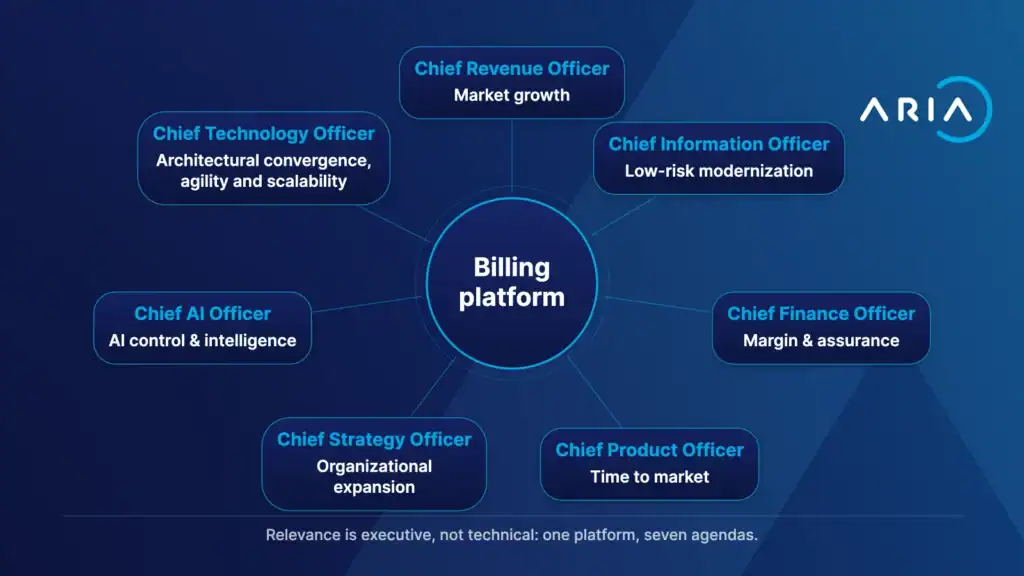
Its relevance therefore depends on whether it can support the priorities of the wider executive team. This article walks through what relevance looks like for seven CSP executive roles: CRO, CIO, CFO, CPO, CSO, CAIO and CTO. Use it as a checklist when evaluating whether a billing platform can support the wider leadership agenda, not only the technical buyer.
1. Chief Revenue Officer: Accelerate Profitable Revenue Growth
For the CRO, the platform must make it easier to convert network capabilities, digital services and partner propositions into revenue. This means supporting attractive subscriptions covering old and new consumption traffic, outcome-based value propositions, prepaid, postpaid and hybrid models across consumer, enterprise and wholesale markets.
For outcome-based propositions, the platform must connect measurable customer results, such as service availability, completed transactions, resolved interactions or achieved performance levels, to usage pricing, contractual commitments and billing. This allows the CSP to move beyond charging for access or usage and participate in the value its services create.
It should enable the CSP to launch offers quickly, combine connectivity with digital products, monetize APIs and AI services, and manage complex B2B2X partner relationships. Real-time usage visibility, credit controls, bill-shock prevention and revenue-leakage detection are equally important because growth only matters when it produces collectible, profitable revenue.
2. Chief Information Officer: Modernize Without Creating Unacceptable Transformation Risk
For the CIO, the central question is whether the platform can simplify the BSS estate without requiring another disruptive, multi-year replacement program.
A relevant platform should be modular, cloud-native and API-first. It must coexist with existing charging, mediation, CRM, ERP, order management, provisioning, AI tools and customer-care systems, allowing the CSP to migrate products, customer groups or business units in phases. It should also support consolidation following acquisitions and help retire redundant billing platforms over time.
Strong security, regional data residency, operational resilience and compliance with standards such as GDPR, PCI DSS and SOC 2 are fundamental. So too is the ability to integrate with enterprise-wide platforms and AI infrastructure and development platforms from vendors such as Salesforce, ServiceNow, Microsoft, AWS, Google and Oracle without excessive custom development.
3. Chief Financial Officer: Improve Margin, Control Cost and Strengthen Revenue Assurance
For the CFO, billing relevance is measured through financial control. The platform must calculate charges accurately, reduce revenue leakage, improve collections and provide a reliable audit trail from usage event to invoice, payment and revenue recognition.
It should also lower total cost of ownership by reducing infrastructure, customization, manual reconciliation and specialist support requirements. Real-time cost and margin controls become particularly important when monetizing services such as AI, cloud infrastructure, APIs and digital content, where supplier costs can accumulate faster than customer revenue.
The CFO should be able to understand the profitability of an offer, customer, channel or partner, not simply the revenue it generates.
Article
Best Billing Software for Telecoms and BSS in 2026
CSPs need billing that can launch 5G, fibre, IoT, APIs, AI and partner offers without cost and complexity rising at the same rate. This guide compares eight SaaS-native and telecom-native platforms across growth, modernization, TCO and convergent charging, including Aria Systems, Amdocs, Netcracker, Oracle, Huawei, Cerillion, Zuora and BillingPlatform.

4. Chief Product Officer: Turn Product Ideas Into Market-Ready Offers Faster
For the CPO, the billing platform should remove commercial friction from product development. Product teams need to configure pricing, packaging, discounts, entitlements, commitments, allowances and usage rules without waiting for lengthy billing-system releases.
A relevant platform should support rapid experimentation and allow the CSP to launch and refine propositions across 5G, fiber, IoT, AI, APIs, content, marketplaces and enterprise services. It should accommodate subscription, consumption, hybrid and outcome-based business models, including the ability to measure defined results and connect them to pricing, entitlements and contractual commitments. It should also support personalized offers, engagement and bundles that combine traditional connectivity with third-party and digital products.
The measure of success is not how many billing features the platform contains. It is how quickly the business can move from a product concept to a scalable, monetized service.
5. Chief Strategy Officer: Enter New Markets and Build Ecosystem Business Models
For the Chief Strategy Officer, the platform must support growth beyond the CSPs’ traditional subscriber base. This includes expansion into enterprise platforms, API economies, IoT ecosystems, AI services, digital marketplaces and other adjacent categories.
The platform should support multi-party and outcome-based commercial models in which the CSP may act as service provider, marketplace operator, wholesaler or billing agent. It must be able to manage partner hierarchies, measure agreed outcomes, and support revenue sharing, commissions, wholesale charging and billing-on-behalf-of arrangements.
It should also provide the flexibility needed to integrate acquisitions, test new ventures and establish joint propositions without creating a separate billing stack for every initiative.
6. Chief AI Officer: Monetize AI and Unlock Billing Intelligence for Operational Excellence
For the Chief AI Officer, a modern billing platform has two distinct roles: controlling and monetizing AI consumption, and making trusted billing data and capabilities available to enterprise AI systems.
First, the platform should meter AI consumption at a granular level, including tokens, models, prompts, agents, workflows, API calls and infrastructure usage. It should support subscription, usage-based, hybrid and outcome-based pricing, while applying budgets, quotas, entitlements and policy rules in real time. This allows the CSP to commercialize AI-native services while controlling internal AI expenditure and protecting margins.
Second, AI assistants and agents should be able to access billing intelligence securely and act on it within defined permissions. This includes customer balances, usage, entitlements, invoices, payments, disputes and account history. Governed access to this data can improve customer service, collections, revenue assurance, bill-shock prevention, churn management and offer personalization. Where permitted, AI agents should also be able to initiate controlled billing actions from customer-care, CRM, collaboration and other enterprise platforms.
Auditability is essential on both sides. The CSP must be able to identify which customer, user, application or agent consumed an AI service, accessed billing data or initiated a commercial action. Strong identity controls, policy enforcement, explainability and human oversight allow AI to improve operational performance without compromising security, customer trust or financial accountability.
7. Chief Technology Officer: Support Real-Time, Convergent Services at Telecom Scale
For the CTO, the platform must deliver telco-grade reliability that CSPs must engineer for the operational realities of a communications network.
It should support both online and offline charging, processing exceptionally high volumes of network, application, API, AI and IoT events with the availability and latency required for customer-facing services. Online charging enables in-session balance reservations, authorization, threshold actions and service controls, while offline charging supports the accurate rating and aggregation of completed usage records.
Convergence should extend across these charging modes as well as across prepaid, postpaid, consumer, enterprise and wholesale services. Customers should be able to receive a consistent balance, entitlement and billing experience even when an offer combines connectivity, devices, content, cloud services and partner products.
The platform must also integrate cleanly with the wider OSS and network environment, including mediation, policy control, provisioning and service assurance.
Ultimately, a billing platform becomes strategically relevant when it connects network and digital-service consumption to commercial outcomes in real time. The strongest platforms give CSPs the freedom to launch new business models, modernize incrementally, govern new AI-enabled services, protect margins and grow beyond traditional connectivity without allowing operational complexity to grow at the same rate.
A billing platform earns its place when it serves the whole executive agenda: growth, modernization, margin, product speed, ecosystem strategy, AI monetization and telco-scale control.
Book a demo to see how Aria Billing Cloud and Allegro support CSP monetization across these priorities.
Frequently asked questions about billing for CSPs
